Finishing
Olive Green Lattice Dining Set
A square glass-topped table and four lattice-back chairs, carried from a pale whitewashed finish to an even olive green.
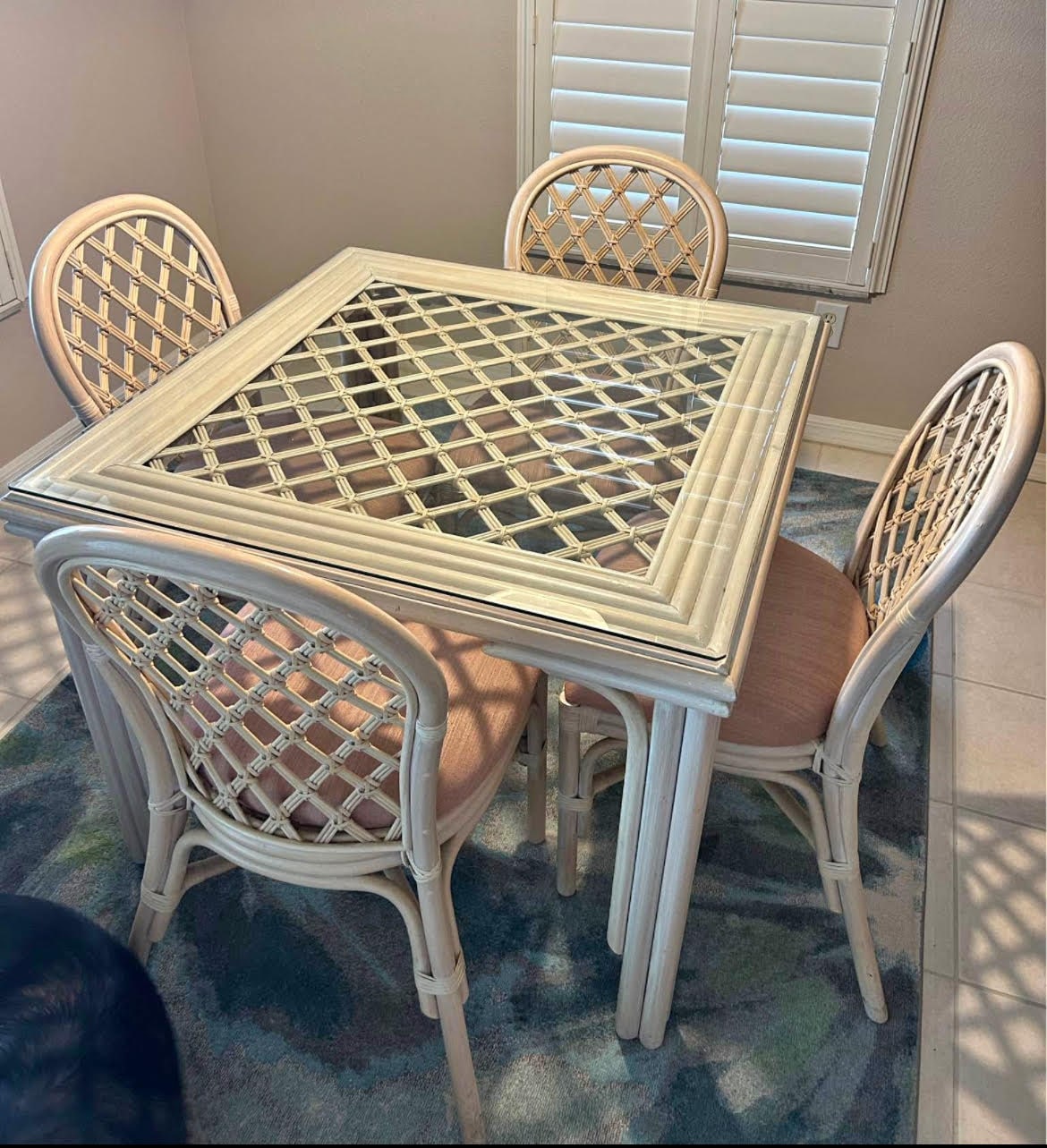
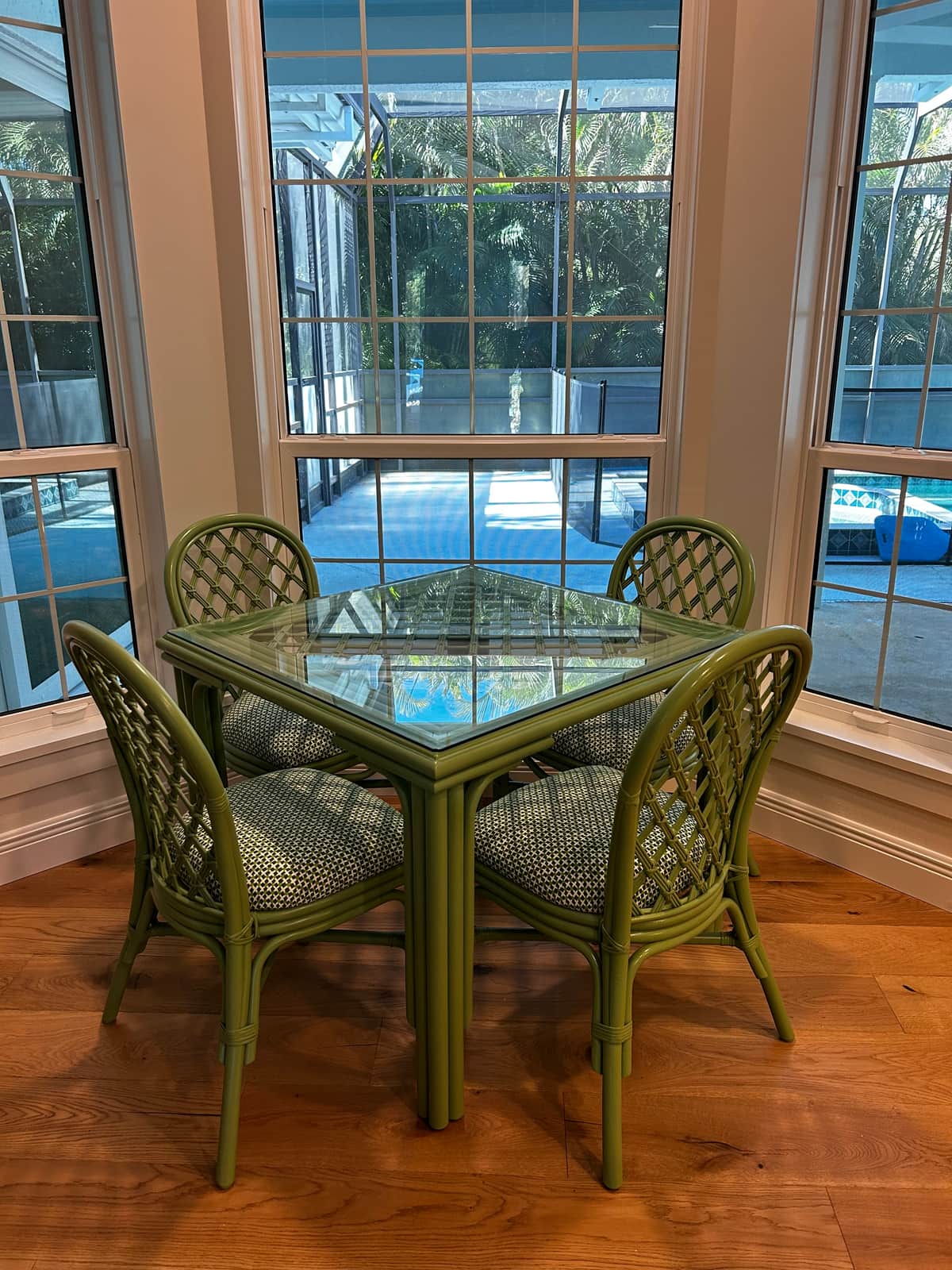
In short This project was a square glass-topped dining table with four matching lattice-back chairs. In the before photograph the bent-pole frames and woven lattice panels carry a pale, mottled whitewashed finish; in the after photograph the whole set is a single even olive green with enough sheen to catch highlights along every pole, and the glass top sits clear over the table lattice.
What the photographs show
Before. The set stands on a patterned teal rug over tile, lit hard from a shuttered window. The table is square, its glass top laid over a lattice grid set into the frame. The four chairs have rounded backs, each filled with a woven lattice panel, and every frame in the set is built from bent poles bound at the joints with wrapped ties. All of it carries a pale, whitewashed finish, mottled and uneven where the light crosses it. The seat cushions are a faded dusty pink.
After. The same square table and four chairs, photographed in a bay window over a wood floor. The frames are now a single, even olive green, dense enough to hide the pale finish underneath completely and glossy enough to pick up a highlight along the length of every pole. The wrapped bindings and the lattice panels are the same color as the frames, so the pattern of the piece reads as shape rather than as a change of tone. The glass top is clear, and the table lattice shows through it.
One thing we did not do
The seat cushions carry a different fabric in the after photograph — a small black-and-cream geometric weave in place of the dusty pink. Re-covering seats is not work this workshop takes on. Our part of this set was the frames and the finish on them.
About these photographs
This entry is built from the workshop’s own photographs of the job. The description above states only what is visible in the two frames — form, color, finish, and the condition of the surface. It makes no claim about the age of the set, the material it is built from, or who made it, because a photograph cannot show any of those things.